
Deep Knowledge Group Advances Hong Kong AI and Health Agenda at InvestHK Event

Dmitry Kaminskiy’s May 2026 Hong Kong visit connected the latest Global AI Competitiveness Index launch cycle with DKG’s broader Hong Kong agenda across AI, health, biotechnology, longevity, finance and ecosystem intelligence.

In May 2026, Dmitry Kaminskiy, General Partner of Deep Knowledge Group (DKG), visited Hong Kong in connection with the latest Global AI Competitiveness Index launch cycle and DKG’s expanding Hong Kong-facing analytical agenda. The visit connected several strands of DKG’s recent work: the launch of Global AI Competitiveness Index Part 6, the release of the AI in BioTech, Healthcare and Longevity in Hong Kong ecosystem platform and report, and direct presentation activity around AI and health in Hong Kong at an InvestHK event.
The visit was not a standalone trip or a ceremonial appearance. It reflected the next phase of DKG’s Hong Kong strategy: moving from research, benchmarking and ecosystem mapping into active institutional engagement around AI, health, biotechnology, longevity, finance and the practical conditions required for advanced technology deployment. It also built on the public visibility already created by DKG’s Hong Kong-focused AI platforms, the Global AI Competitiveness Index series and the international attention surrounding Hong Kong’s AI positioning.
From AI Index Launch to Hong Kong Ecosystem Engagement
The May 2026 launch of Global AI Competitiveness Index Part 6: AI in BioTech, Healthcare and Longevity extended the AI Index Consortium’s benchmarking programme into one of the most strategically important applied domains of artificial intelligence. The edition examines how countries and city-level hubs convert AI capability into deployable biomedical systems, including clinical validation, health-data infrastructure, regulatory maturity, capital formation and commercialization pathways.

The launch was accompanied by a dedicated AI in BioTech, Healthcare and Longevity in Hong Kong report and ecosystem platform. The Hong Kong-specific project maps the city’s AI-enabled life-sciences ecosystem across research, translational capacity, clinical data readiness, governance, capital formation, public programmes and ecosystem coordination. It builds on DKG’s prior Hong Kong analytical sequence, including the AI in Hong Kong platform and the AI for Finance in Hong Kong platform and report.
This sequence is important because it shows how DKG’s work in Hong Kong has developed from general AI ecosystem mapping into specialized sectoral intelligence. First came the city-level AI industry ecosystem view; then the finance-focused AI platform and report; and now the BioTech, Healthcare and Longevity edition, which links AI competitiveness to clinical, biomedical and longevity-related deployment readiness.

Presenting AI and Health in Hong Kong at InvestHK
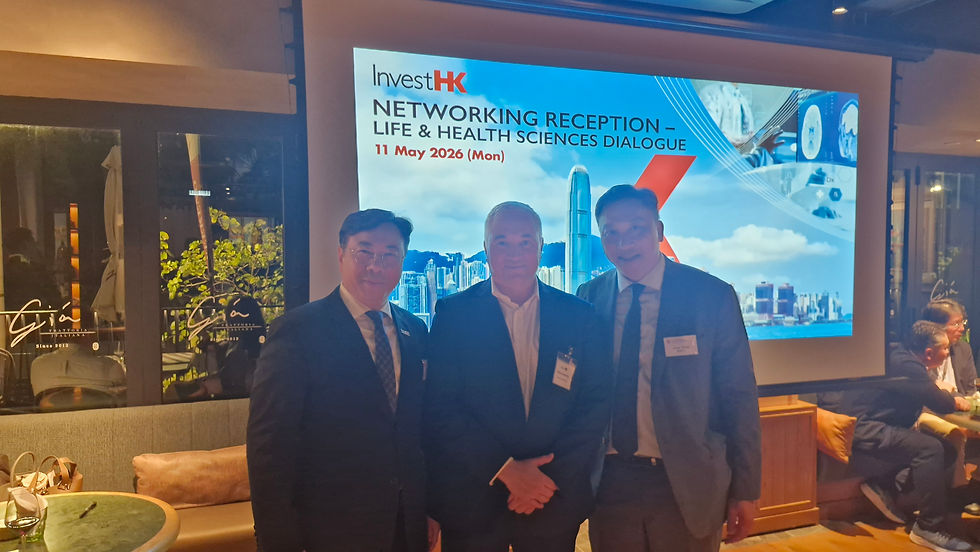
During the visit, Dmitry also presented DKG’s analysis of AI and health in Hong Kong at an InvestHK event. This provided a setting to connect DKG’s analytical findings with Hong Kong’s wider investment, innovation and life-sciences agenda. The presentation highlighted how the city’s distinctive strengths - capital-market depth, institutional credibility, international connectivity, Greater Bay Area proximity and policy interest in life and health technology - create conditions for AI-enabled health and biomedical innovation.
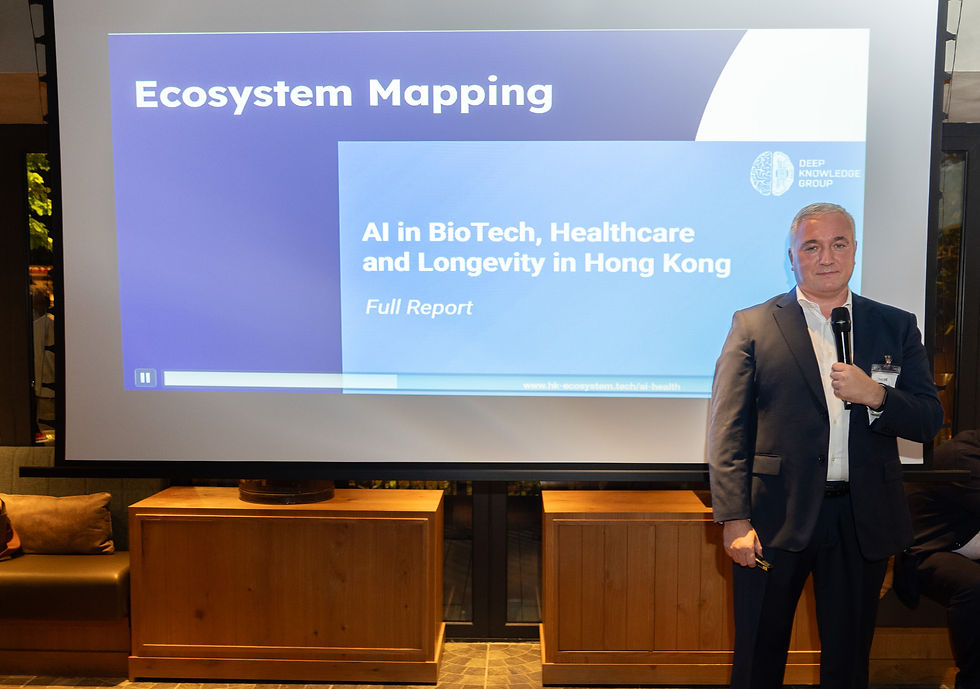
The InvestHK-linked presentation was also an opportunity to communicate DKG’s broader Hong Kong agenda: previous projects already launched, current analytical platforms, and upcoming initiatives designed to deepen Hong Kong-focused ecosystem intelligence. This agenda is not limited to one report or one event. It includes a continuing programme of country and city benchmarking, sectoral ecosystem mapping, platform development, investment-intelligence dashboards and institutional engagement around applied AI.
Why Hong Kong Matters for DKG’s AI and Health Agenda
Hong Kong occupies a distinctive position in DKG’s global AI and health analytics strategy. It is not simply a city with AI ambition. It is a high-trust international financial centre with strong legal and regulatory infrastructure, institutional credibility, world-class connectivity, proximity to the Greater Bay Area and growing relevance in life and health technology. These features make Hong Kong especially important for sectors where AI must be validated, governed, financed and scaled responsibly.
In finance, Hong Kong provides a mature regulated environment for understanding how AI can move from pilot projects into production-grade institutional use. In healthcare, biotechnology and longevity, the city offers a different but related value proposition: the ability to connect clinical capacity, biomedical research, capital markets, cross-border innovation and ecosystem coordination. This is why DKG’s Hong Kong analysis increasingly treats the city as a biomedical AI coordination and scaling hub, not only as a general AI market.

John Lee’s Public Citation and Broader Validation

The latest Hong Kong agenda also sits within a broader context of public validation. In April 2026, Hong Kong’s head of government, John Lee, cited the Global AI Competitiveness Index in his opening speech at the World Internet Conference Asia-Pacific Summit, referencing Hong Kong’s high ranking in an earlier DKG benchmark. The citation was significant because it placed Hong Kong’s AI positioning within a comparative analytical framework rather than a purely promotional claim.
Hong Kong’s head of government, John Lee, citing the Global AI Competitiveness Index during the WIC Asia-Pacific Summit. Video link: https://www.youtube.com/watch?v=_CfN7URWSfU
Lee’s speech emphasized many of the same structural conditions that DKG’s Hong Kong analysis has examined: common-law institutional credibility, free flow of information and capital, Greater Bay Area connectivity, the Hetao Shenzhen-Hong Kong Science and Technology Innovation Co-operation Zone, compute infrastructure, research clusters and responsible innovation. These themes reinforce the logic behind DKG’s Hong Kong-facing AI platforms and the city’s role as a practical test case for deployment-oriented AI competitiveness. The speech can be viewed here.
From Reports to Platforms, Dashboards and Ecosystem Intelligence
DKG’s Hong Kong work is increasingly organized around a practical progression: analytical report, mapped ecosystem platform, media visibility, institutional engagement and then deeper intelligence products. The same pattern has appeared across AI in Hong Kong, AI for Finance in Hong Kong and AI in BioTech, Healthcare and Longevity in Hong Kong. Each project combines benchmarking with mapped ecosystem data, giving decision-makers a more structured view of where AI activity is concentrated and how it connects to institutions, investors, companies, hubs and government bodies.
This is also why Dmitry’s May visit matters strategically. It connected the public launch cycle to direct presentation, networking and institutional discussion. The reports and platforms provide the analytical base; the Hong Kong visit helped translate that base into active dialogue around implementation, investment relevance and future project development.

A Continuing Hong Kong Programme
Looking ahead, DKG’s Hong Kong agenda will continue to expand across AI competitiveness, health technology, biotechnology, longevity, finance, industrial ecosystem mapping and applied DeepTech intelligence. The purpose is not only to describe Hong Kong as an AI hub, but to map the institutional, commercial and technological conditions that make advanced AI deployment possible in high-value sectors.
Hong Kong’s relevance lies in the convergence of several systems: finance, governance, innovation policy, medical and life-sciences infrastructure, regional connectivity and international credibility. For DKG, this makes Hong Kong a natural platform for linking global benchmarking with local ecosystem intelligence and for understanding how AI becomes operational in sectors where trust, regulation, data, capital and execution all matter.
Conclusion: Hong Kong as a Strategic Bridge for Applied AI
Dmitry Kaminskiy’s May 2026 Hong Kong visit illustrated the transition from analysis to engagement. The Global AI Competitiveness Index provides the international benchmark; the Hong Kong ecosystem platforms provide the local analytical layer; InvestHK-facing presentation activity creates institutional visibility; and public recognition by Hong Kong’s head of government reinforces the city’s place in the broader AI competitiveness conversation.
Together, these elements show why Hong Kong has become a priority geography for DKG’s AI and health agenda. The city is not only a subject of analysis. It is a strategic bridge between global capital, Asian innovation systems, Greater Bay Area scale, regulated deployment environments and the next generation of AI-enabled health, biotechnology, finance and longevity infrastructure.


Spent way too long on Poki last weekend — started with one puzzle game and ended up trying like five different ones. Everything loads right in the browser which is nice when you just want something quick without installing anything. The variety is honestly what keeps me coming back.
mình có lần lướt đọc mấy trao đổi trên mạng شيخ روحاني thì thấy nhắc nên cũng tò mò mở ra xem thử cho biết. mình không tìm hiểu sâu chỉ xem qua trong thời gian ngắn để quan sát bố cục cách sắp xếp جلب الحبيب các mục và trình bày nội جلب الحبيب dung tổng thể. cảm giác là các phần được trình bày khá gọn, các hurentest berlin mục rõ ràng Huren Berlin nên đọc lướt cũng không bị rối với mình như vậy là đủ để nắm tin cơ bản rồi. جلب الحبيب
👍
Me gustó mucho la información presentada porque está explicada de forma clara y resulta fácil de seguir. Para las personas interesadas en la loteria, consultar resultados, fechas y datos recientes puede ser muy práctico. Este tipo de recursos ayuda a encontrar información relacionada con los sorteos de manera más sencilla.
Many homeowners searching Bathroom Vanity Canada want full-extension drawers because items stored toward the back remain easier to access.
The core message is about connecting advertisers with premium publishers through a performance-driven framework. That is a practical angle for anyone evaluating regional networks. The Asia-focused network details summarize the intended value without overcomplicating the pitch.