
Head of Hong Kong Government Cites Global AI Competitiveness Index in Opening Speech for WIC Asia-Pacific Summit

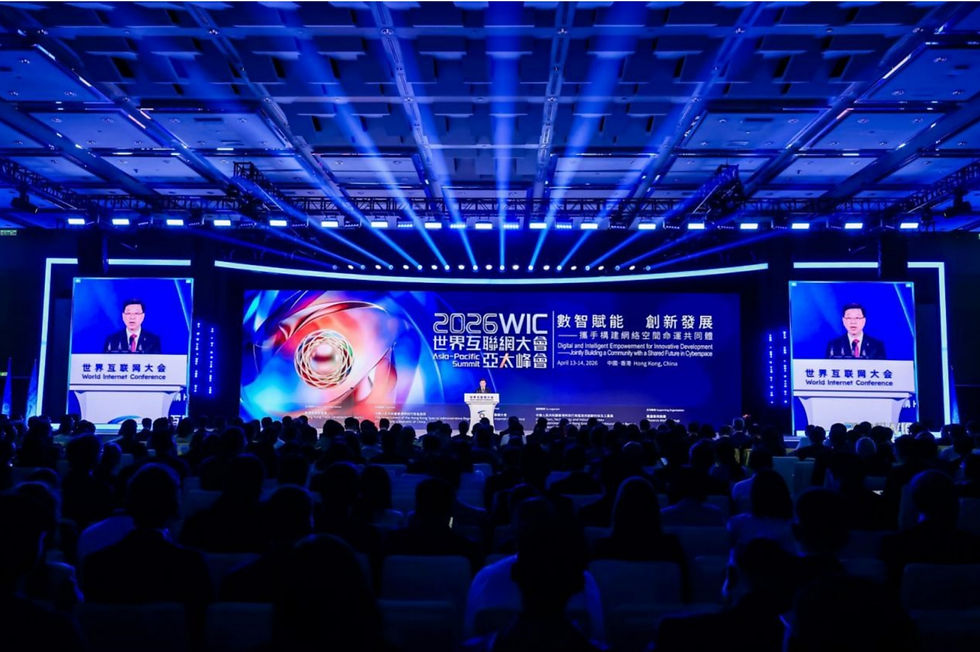
In his opening speech at the World Internet Conference Asia-Pacific Summit, Hong Kong Chief Executive John Lee set out a detailed case for why the city believes it is entering a more operational phase of artificial-intelligence development. He spoke about Hong Kong’s role under “one country, two systems”, its common-law system and free flow of information and capital, its place in the national innovation agenda, the Greater Bay Area, the Hetao Shenzhen-Hong Kong Science and Technology Innovation Co-operation Zone, new compute infrastructure, research clusters, AI literacy, and responsible innovation. In the same speech, he cited the Global AI Competitiveness Index and said Hong Kong came third after New York and London. That reference is notable because it anchors the city’s AI narrative in a comparative benchmark rather than in a purely promotional claim.
Lee’s speech is substantial enough to deserve close reading on its own terms. It is not a short set of ceremonial remarks. It is a structured statement about how Hong Kong wants to compete in AI: through infrastructure, institutional trust, cross-border innovation capacity, and an increasingly explicit strategy for turning research and policy support into real deployment. Read alongside the AI for Finance in Hong Kong report, the wider AI in Hong Kong ecosystem report, and the broader Global AI Competitiveness Index report series, the speech reads less like a standalone political address and more like public confirmation of structural trends that have already been taking shape.
A speech built around infrastructure, integration, and trust
Lee began by framing the summit itself as a signal of Hong Kong’s international position. He noted that the World Internet Conference Asia-Pacific Summit had returned to Hong Kong for a second consecutive year and that the 2026 edition brought together more than 1,000 high-profile participants from around 50 countries and regions. That mattered because it positioned Hong Kong not simply as the host of a conference, but as a place where international digital cooperation and cross-border technology dialogue can happen at real scale.
A central part of the speech was Hong Kong’s role in the country’s broader development strategy. Lee said the National 15th Five-Year Plan continues to support Hong Kong’s development as an international innovation and technology hub and as a contributor to the Guangdong-Hong Kong-Macao Greater Bay Area. He used the Hong Kong Park of the Hetao Shenzhen-Hong Kong Science and Technology Innovation Co-operation Zone as the clearest expression of that strategy. According to the speech, the park has already attracted more than 70 tenants from sectors including artificial intelligence and data science, life and health technology, and new energy.
The compute section of the speech was especially significant. Lee said Hong Kong’s overall computing power had risen to 5,000 petaFLOPS following the launch of Cyberport’s AI Supercomputing Centre in December 2024. He then pointed to the upcoming Sandy Ridge data facility cluster, which he said would expand that figure to 180,000 petaFLOPS by 2032. Those numbers are important not because compute by itself guarantees leadership, but because the public emphasis on compute shows that Hong Kong’s AI strategy is becoming more infrastructure-conscious. Cities that want to attract AI companies, labs, enterprise use cases, and international partnerships need to show that they can support serious workloads, not only host conferences or issue policy statements.
The speech also made room for access and governance. Lee said that under “AI+” and “AI for all” campaigns, companies, employees, civil servants, students, and even the older population would gain better access to AI literacy programmes. He added that Hong Kong recognises the need to balance AI’s power with responsible and inclusive use. That point matters in its own right, but it matters even more in a place like Hong Kong, where AI competitiveness is likely to be strongest in sectors such as finance, healthcare, and other domains where trust, auditability, and institutional legitimacy are central.
Why the index citation matters
Lee’s citation of the Global AI Competitiveness Index should therefore be read in that broader context. It was not just a passing boast or a throwaway ranking reference. It served to place Hong Kong’s self-description inside a benchmark framework that evaluates AI strength across multiple dimensions rather than through a single headline metric.
That is what gives the citation weight. The Global AI Competitiveness Index series does not look only at abstract innovation capacity. Across its different parts, it examines enterprise activity, scientific research, human capital, governance and regulation, and finance, economy, and financial services. In practical terms, it asks how a jurisdiction builds an AI ecosystem, which layers of that ecosystem are strong, and whether those layers connect in ways that support real deployment.
How the Hong Kong reports support that case
The local Hong Kong reports make that argument more concrete. The AI for Finance in Hong Kong publication maps the city’s AI-finance landscape in far greater detail than a normal policy note or launch announcement. In the visual summary used for the project, the mapped ecosystem includes 160 companies, 50 investors, six universities and training providers, four government bodies and regulators, and five hubs. Those are not abstract labels. They provide a structured picture of how Hong Kong’s AI-finance ecosystem is actually composed and where the city’s density lies.

Meanwhile, Deep Knowledge Group’s earlier AI in Hong Kong industrial ecosystem platform and report, released in cooperation with the AI Industry Association of Hong Kong with the FSDC as report observer, extends the argument beyond finance. It shows that Hong Kong’s AI positioning depends on a broader ecology involving research institutions, universities, technology hubs, government bodies, associations, and commercial actors. That wider view is important because it aligns closely with the government’s own emphasis on the Hetao zone, the San Tin Technopole, compute build-out, and AI literacy. The speech and the reports reinforce one another: one sets out the public strategic direction, the other maps the ecosystem components that make that direction plausible.

Dmitry Kaminskiy (Deep Knowledge Group), Niel Tan (AI Industry Association of Hong Kong), King Au (former Executive Director of the Hong Kong Financial Services Development Council and Current CEO of Nina Wang Charity Management Limited) and Patrick Glauner launching AI in Hong Kong and Global AI Competitiveness Index Part 4.
The launch context around these projects is also significant. The finance report and Global AI Competitiveness Index Part 5 were launched with the Financial Services Development Council serving as observer. The role of the Financial Services Development Council is important because it places the work inside a serious institutional and policy-facing context while preserving analytical independence. That makes the Hong Kong material more useful than a promotional campaign. It becomes part of a broader conversation about whether Hong Kong can translate AI into durable financial and institutional advantage.
From finance into healthcare, biotechnology, and longevity
Lee’s speech also hints at why Hong Kong’s AI relevance extends well beyond finance. His references to life and health technology, cross-boundary flows of bio-samples, the Hetao zone, and stronger full-chain innovation support all point toward a city that could become increasingly important for AI in healthcare and the life sciences. In that sense, the speech is not only about digital policy or fintech. It outlines the physical and institutional ingredients of a broader high-value innovation environment.
The same structural logic appears across the Global AI Competitiveness Index series. Jurisdictions matter not only because they have models, startups, or publicity. They matter because they can combine infrastructure, capital, research, governance, and industrial pathways into something usable. Hong Kong’s opportunity lies precisely there. It is not simply another city claiming to be an AI hub. It is one of the places where multiple layers of AI competitiveness can plausibly reinforce one another.
Conclusion
That is why Hong Kong’s AI competitiveness moment matters. It is not only about where the city ranks. It is about the way several layers are now moving together: public policy, compute infrastructure, cross-border innovation capacity, ecosystem density, international financial relevance, and a wider regional role inside the Greater Bay Area. For Deep Knowledge Group, that combination makes Hong Kong not just a city worth analyzing, but a region worth building around.


The content was truly engaging and informative. I sincerely appreciate you for sharing such valuable insights. You made an excellent point, and I completely agree with your perspective. Thank you for contributing this helpful information. Santa Suit
Hong Kong’s progress in AI highlights how technology is shaping modern cities and innovation. For Halloween enthusiasts, a black cape halloween costume offers a timeless way to create a mysterious look.
I really enjoyed reading this content. Thank you for providing such unique and useful information. Your point of view is excellent, and I fully agree with what you've shared. Thanks for sharing your thoughts with us! Snoopy Puffer Jacket
The focus on global AI competitiveness highlights how quickly technology is shaping economies, industries, and international collaboration. It is interesting to see how events like the WIC Asia-Pacific Summit bring attention to emerging developments and future opportunities. Innovation influences fashion as well, and womens jackets continue to evolve through new materials, designs, and practical styling.
Great comparison of wrenches and pliers. Knowing which tool suits a specific task can make everyday repairs much easier. Even when working on clothing racks, displays, or fixtures in a ladies apparel store, having the right hand tool helps keep everything secure and organized. This practical guide makes choosing between them simple.